
Key Takeaways
- Age concessions are a major win: Many 2026 DAMAs let eligible workers stay on track for Permanent Residency up to 55 years old.
- English settings are more flexible: Some pathways can work with IELTS 5.0 overall, depending on the agreement and occupation.
- Regional salary rules are more workable: DAMA concessions can reduce the effective salary barrier for approved employers by 10%.
- PR pathways can move faster: Many DAMA streams give you a clearer route to the 186 visa after two years of regional work.
- Regional coverage is expanding: State-wide and broader DAMA frameworks are making DAMA jobs Australia easier to access in 2026.
What is a DAMA?
A Designated Area Migration Agreement (DAMA) is a formal agreement between the Australian Government and a regional authority that allows employers in specific areas to sponsor overseas workers under more flexible rules.
In plain English: if standard sponsorship feels too tight, a DAMA can open the door.
Unlike the standard Subclass 482 (Skills in Demand/TSS-linked) or Subclass 494 pathways, a DAMA can include occupations that are not available through the usual national lists. It can also apply concessions on age, English, and salary where regional labour shortages are hard to fill locally.
That is why DAMA jobs Australia matter. They are not just “regional jobs.” They are jobs tied to a migration framework built to help employers fill genuine shortages and help workers qualify where metro pathways may shut them out.
In 2026, that framework is becoming broader and more useful. Regions are moving toward larger, easier-to-navigate DAMA structures, giving skilled and semi-skilled workers a more realistic path into regional visa sponsorship Australia.
DAMA Changes for 2026: The New Landscape
If you want results in DAMA jobs Australia, you need to understand the 2026 shifts shaping employer demand and visa strategy:
- WA is going broader: On 4 April 2026, the Goldfields DAMA transitioned into the WA State-Wide DAMA. That is a major structural shift and a big simplification for workers targeting regional Western Australia.
- TSMIT is higher, but DAMA still creates room: From 1 July 2026, the Temporary Skilled Migration Income Threshold rises to $79,499. Under many DAMAs, employers can still access a 10% concession, which can bring the practical threshold closer to $71,550.
- Some occupations are moving to industry agreements: Roles covered by federal Industry Labour Agreements (ILAs) may no longer sit inside certain regional DAMAs. If you work in aged care, meat processing, or similar sectors, your pathway may depend on the correct agreement type.
- The PR pathway is getting sharper: Many DAMAs now offer a clearer route to the Subclass 186 Employer Nomination Scheme after 2 years of regional employment. That is one of the biggest strategic advantages over standard sponsorship settings.
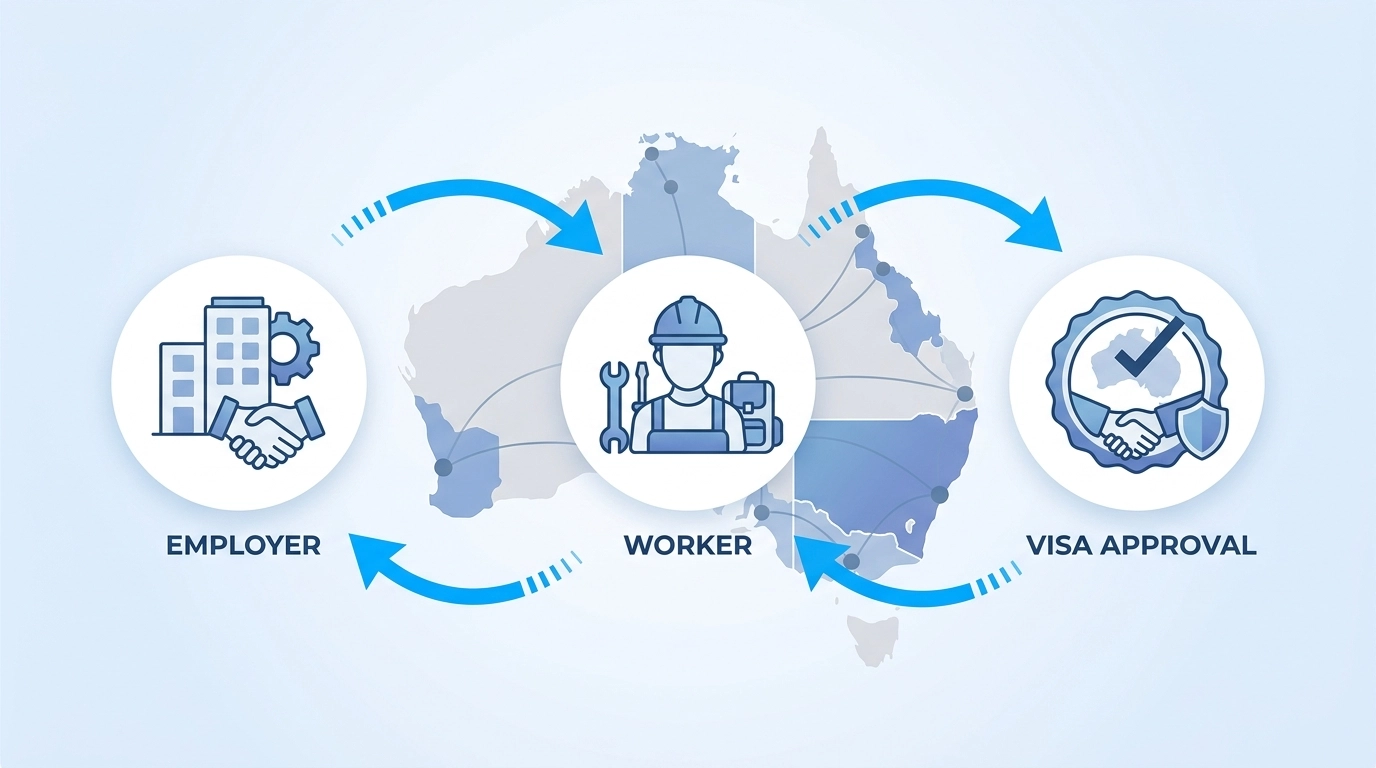
What This Means for Applicants and Employers
These changes are not background noise. They directly affect how you should approach skilled migration Australia in 2026.
- If you are an applicant, your options may be wider than you think. If you are over 45, have borderline English scores, or work in a semi-skilled occupation, DAMA may turn a “no” into a workable pathway.
- If you are an employer, DAMA is a retention tool. A faster PR pathway is not just good for the worker. It also helps regional businesses attract and keep staff in hard-to-fill roles.
- If you are planning strategically, location matters. Not all regional areas are equal. The right DAMA region can mean better concessions, a broader occupation list, and a faster transition plan.
- If you are preparing a nomination, precision matters. Employers must align job titles, duties, and ANZSCO codes correctly. One mismatch can slow down or derail the process.
Quick read: what this means in practice
- If you need age flexibility: Focus on DAMA regions with concessions up to 55.
- If salary is the sticking point: Target employers using a valid TSMIT concession.
- If PR speed matters most: Prioritise DAMA pathways with a clear 186 transition after 2 years.
- If you want fewer dead-end applications: Focus only on accredited sponsors.
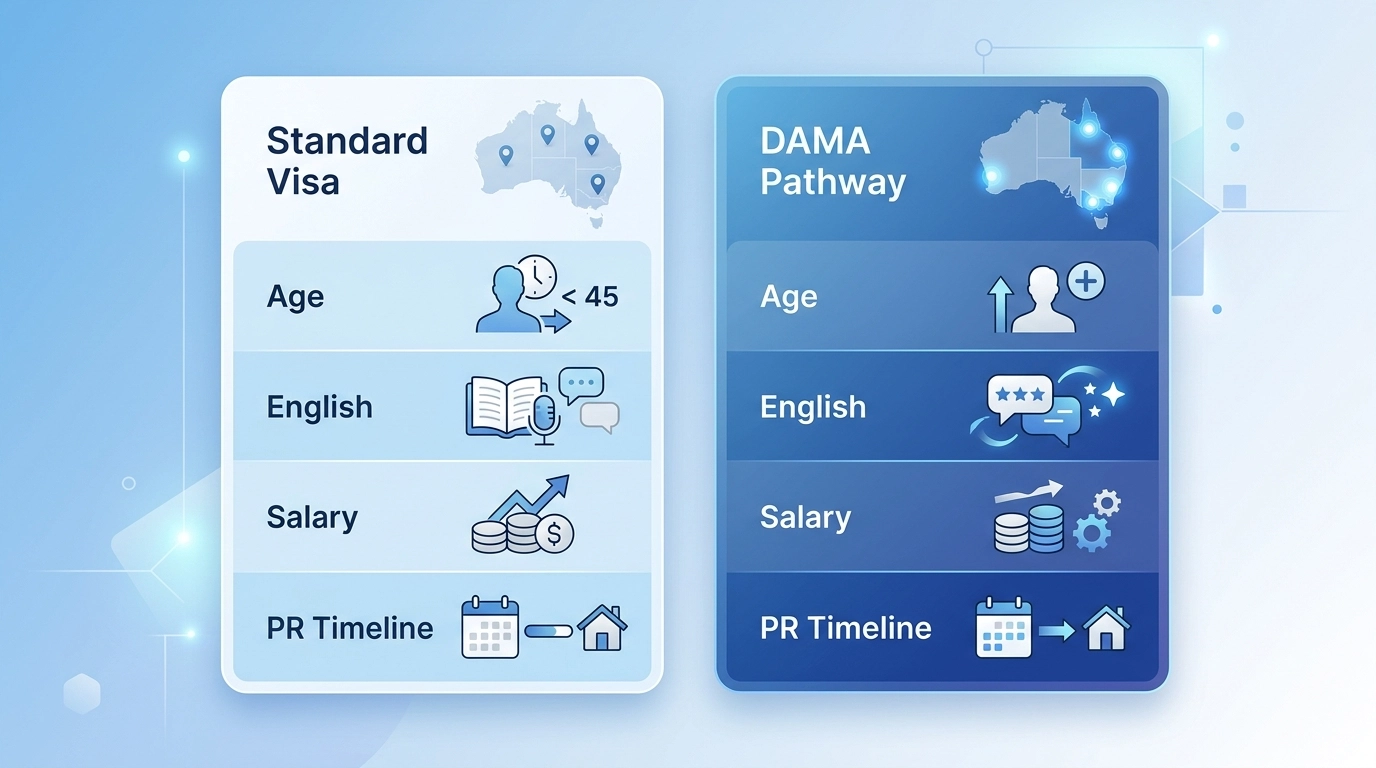
Comparing Standard Sponsorship vs. DAMA Concessions
If you are deciding between a standard sponsorship pathway and a regional DAMA route, this is the difference that matters:
| Feature | Standard 482/186 Pathway | DAMA Pathway (Regional) |
|---|---|---|
| Age Limit for PR | Usually under 45 | Up to 55 years in many agreements |
| English Proficiency | Higher benchmark, often IELTS 6.0+ | Often reduced to IELTS 5.0 overall |
| Salary Threshold | Full TSMIT applies | 10% concession may apply |
| Occupation Access | Limited to standard skilled lists | Regional lists can include semi-skilled roles |
| PR Pathway | Standard timelines apply | Often clearer after 2 years regional work |
What a DAMA Allows: Key Benefits
This is where DAMA jobs Australia become a real opportunity rather than just another search term.
- More occupations: Some DAMAs cover roles outside the standard national lists, including a range of semi-skilled occupations.
- More flexibility: English, salary, and age concessions can make a role viable when a standard sponsorship pathway does not.
- More regional access: Employers in hospitality, agriculture, transport, health support, and other regional sectors can use DAMAs to fill genuine shortages.
- More migration certainty: Many agreements create a more structured transition toward Permanent Residency, which makes them attractive to both workers and employers.
Bad vs Good mindset
- Bad: Applying for any “visa sponsorship” job and hoping the employer can sponsor.
- Good: Targeting accredited sponsors in DAMA regions where the role, concession settings, and PR pathway actually line up with your profile.
Eligibility Criteria: Are You Ready?
Before you spend time applying, run this quick DAMA checklist:
- Your employer is eligible: The business should be an Accredited Sponsor or have a sponsorship pathway in place, plus the required regional support.
- Your occupation is covered: The job must match an occupation available under the relevant DAMA or linked agreement.
- Your experience stacks up: Most roles still expect 1-2 years of relevant experience.
- Your licensing and skills requirements are clear: Some roles need a skills assessment, registration, or trade evidence.
- Your health and character documents are ready: Medicals and police clearances still apply.
- You are genuinely willing to live regionally: DAMA is a regional pathway, not a shortcut into metro Australia.

How OzJobList Simplifies the DAMA Search
The biggest problem with most job boards is simple: they show jobs, but they do not show whether the employer can actually sponsor you.
That is where OzJobList is different.
We focus specifically on accredited sponsors, regional pathways, and practical tools that help you act faster and smarter.
- Accredited Sponsor Directory: Search businesses sourced from official Department of Home Affairs data so you can focus on employers already approved to sponsor 482 and 186 visas. That means fewer wasted applications and a better hit rate.
- DAMA Pathway Information: We help you identify which regional pathways may fit your occupation, background, and migration goals so you are not guessing which area to target.
- Curated Job Listings: Our platform focuses on full-time roles from employers with sponsorship relevance, including opportunities connected to regional Australia.
- ATS CV Builder: Our free tool helps you create an Australian-style resume that is easier for recruiters and applicant tracking systems to process.

Your best move
If you want better outcomes, do this in order:
- Find the right DAMA region
- Check whether your occupation is covered
- Target accredited sponsors only
- Send an ATS-friendly CV tailored to the role
Pro-Tip: The fastest way to waste time is applying blindly. The smarter move is to use OzJobList to build a short list of real sponsors in regional Australia, then approach them with a role-specific CV and clear relocation intent.